
Tension is building between legacy enterprise phone systems and a new, autonomous, agent-driven reality. For decades, the enterprise phone call has been the black box of CRM, creating a disconnected silo where customer data was trapped in unindexed recordings.
As digital channels evolved, the Interactive Voice Response (IVR) experience remained stuck in rigid menus and manual data entry, even as email and chat became automated powerhouses.
But as organizations race toward an artificial intelligence (AI)-first future, a new reality is emerging. The phone call is no longer just a separate channel. It is becoming a native, programmable workflow triggered directly by Salesforce or HubSpot data.
Isaiah Granet, CEO of Bland AI, believes the solution goes beyond better prompts to a deeper integration. By embedding AI agents directly into existing enterprise contact centers and CRMs, his company is helping to demonstrate that high-volume outreach can be both hyper-realistic and sub-800 millisecond, while remaining tightly governed.

In his view, dedicated GPU stacks are killing the legacy "press one-for-sales" menus.
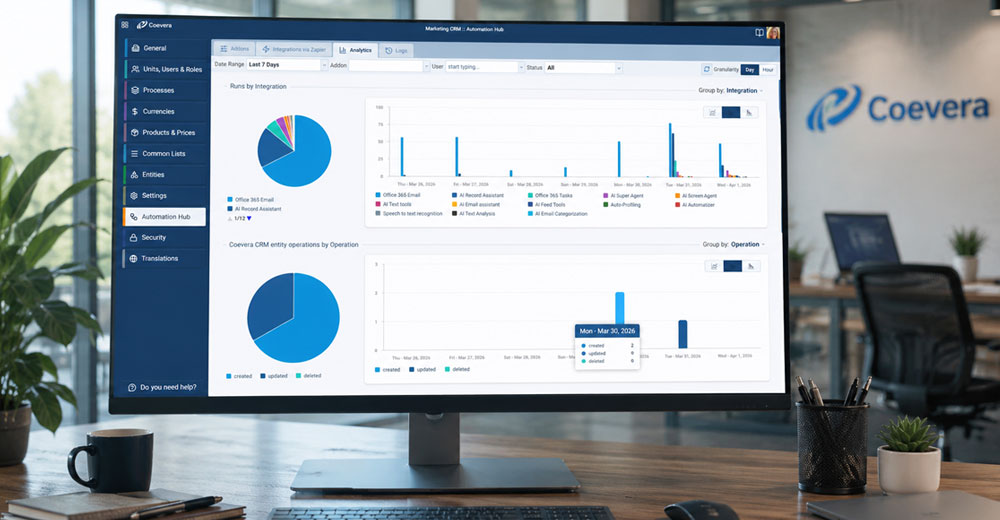
Organizations are replacing traditional contact centers faster than the market realizes. These systems integrate AI agents that do more than talk to customers. They autonomously update a CRM, book meetings, and close the loop without a human ever having to pick up a headset.
Sales admins and teams are seeing a shift in their daily workflow as the phone is no longer a separate app but a programmable trigger within their existing dashboard.
"Fundamentally, it makes it far easier to focus on the things that matter. Instead of being constantly distracted by leads, follow-ups, and scheduling, we are giving back time, so that a lot of the rote work of making sure somebody is contacted in the right timeframe actually happens," Granet told CRM Buyer.
Speed-to-Lead in an AI World
Granet said that connecting Bland to a CRM to dial leads, schedule follow-ups, and handle other tasks saves teams time and reduces mental overhead. We discussed the new enterprise calling engine with Granet.
CRM Buyer: What are the most impactful actions a Bland AI agent can take inside a CRM during a live call?
Isaiah Granet: Bland can read and write from most CRMs seamlessly and natively. This means the call is not coming from a place of ignorance. Our AI agent knows the context surrounding a customer, understands what's happening, and can not only read but also write back and take action inside the CRM in real time.
Many companies struggle with messy data in their CRM. Bland eliminates the need to monitor data quality while also ensuring the phone call itself is personalized and engaging.
As enterprises move from “click-to-call” to “trigger-to-conversation,” what changes most during a live call?
Granet: When you think about a prospect in the sales cycle, the last thing you want is for them to have to repeat themselves. Bland eliminates that overhead. The agent knows the context going in, and all the data is neatly captured when the call ends.
What’s driving enterprises to abandon legacy IVR systems?
Granet: People hate that they can't get the help they need from an IVR. Most people calling in have a problem that they can't get resolved elsewhere. The phone is where you go when you have an urgent, high-value problem that needs fixing right away. An IVR is just far too constrained and rigid.
Bland helps you build flows with guardrails and determinism so you don't hurt your business, promise the wrong thing, or lead a customer down the wrong path, while giving agents the full flexibility to engage with whatever the customer actually needs help with.
How does Bland's Conversational Pathways feature improve discovery for frustrated callers?
Granet: Pathways are essentially a programming language for large language models [LLMs]. They blend determinism and non-determinism, giving you the structure and reliability enterprises require, while preserving the natural, flexible conversation that customers expect.
How do your guardrails address concerns about AI hallucinations during live calls?
Granet: A series of guardrails runs on the conversation as a whole and at each step. They check that we're not saying something inappropriate and that the conversation stays on topic.
The reality for enterprises is that AI will hallucinate, and you can't entirely stop it. You can understand the risk profile and mitigate the big problems.
Is there a clear line between harmless and harmful hallucinations?
Granet: Hallucinations don't have to mean giving away a free car. It could be as small as saying the wrong day of the week. That's something very human and natural, and it's hard to defend against completely.
You can eliminate hallucinations that could genuinely harm the business. Bland does that with guardrails at both the call level and the conversational step level, covering not just what's being said, but why it's being said.
Bland AI emphasizes a self-hosted approach. Why is having dedicated GPUs and infrastructure — rather than relying on third-party APIs — critical for enterprise-scale calling?
Granet: The frontier models are excellent at delivering cutting-edge technology, but they don't consistently provide reliable uptime. Many frontier model providers have slipped to 98% or below, and that gap means real calls are dropping and real customers are frustrated. Bland delivers secure, consistent, scalable phone calls when your customers need them most.
Latency is the silent killer of voice AI. With your sub-800 millisecond response times, what makes a voice AI conversation feel truly responsive to callers?
Granet: You have to know when to reply. That's not always about being fast. Sometimes it means replying quickly; other times it means taking a beat to let someone finish a sentence. Bland is learning live on the call, using models that predict how you're going to speak and when the right moment to respond actually is.
We largely reduced latency by hosting all of our models in one place. When you eliminate the failure points introduced by stitching together third-party services, you get a seamless experience. Pair that with always-learning technology that continuously improves how we interact on the call, and the result is genuinely conversational.
How does Bland address data residency and compliance requirements such as GDPR and CCPA in voice interactions?
Granet: We have automated guardrails out of the box for things like TCPA requests, opt-outs, and other compliance requirements. Legal teams don't have to build new policies from scratch. We give them all the tools to enable and enforce rights directly on the platform.
Our goal isn't just to run compliant calls. It's to run calls that actively improve brand reputation. When we work with enterprise teams during setup, we're aligning not just on what's legally required, but on what's right for their brand. Compliance and trust go hand in hand.
When scaling from 100 to 5,000 concurrent calls, what breaks first — technology or internal processes?
Granet: With most vendors, the technology breaks first. Bland is fully self-hosted and controls all components, allowing us to scale up incredibly rapidly. We more commonly see that the business isn't ready for what an AI-first world actually looks like. They bite off more than they can chew.
We work with organizations to build a safe, reliable, and scalable AI strategy from the start. The worst thing you can do is burn customer trust by scaling with a vendor who relies on seven other vendors to deliver your calls. You need to know who your vendor is using. You need confidence in their reliability.
How should enterprises balance human-like voice quality with transparency?
Granet: Focus on building excellent experiences. That starts with making sure customers understand their options when they engage with AI, not building a phone tree. It means ensuring that as you deploy AI, you have proper guardrails and escalations in place so you're not creating friction or frustration.
Be clear and upfront about using AI. Don't try to hide it. The disclosure doesn't need to be heavy-handed or overwhelming, but you should engage the customer in a way that ensures they're opting in with consent to speak with AI.
AI disclosure in voice calls is a genuinely hot topic. The call should be so good that the disclosure doesn't diminish the experience, but deception is never acceptable. We work with enterprises to ensure their customers understand who — or what — they're speaking with.
When should an AI agent transfer a call to a human?
Granet: The best human agents will always have a place, but we never want the human to be a necessity. If an organization has people who truly understand the ins and outs and are available, that's a real advantage.
On the other side, we built Bland to handle even the most complex interactions, so that escalation to a human is always a choice, not a default. If a caller says "human" or "speak to a representative," we don't just transfer immediately. We engage, confirm intent, and get them to the right place. Where that isn't possible, we communicate clearly why.




















 Loading ...