

The term "social commerce" is the trend du jour for marketers, yet there's confusion in many circles about what that really means. At its core, social commerce is about turning customers into advocates.
Social commerce means many things to many people. Some equate it with capital-I "Influencer" marketing. Others think of it as the process of marketers reaching consumers directly via social media platforms.
Truth be told, the original and most potent form of social commerce is embodied by everyday word of mouth. That is, social sharing in which people recommend their favored things to their family and friends and are rewarded if a purchase is made.
Marketers are putting energy and money behind the first two, but it's the third that has the most impact. Yet, capitalizing on this tactic has proven to be the most elusive for marketers.
The Brass Ring for Advertisers
The power of word-of-mouth marketing is the elephant in the room for retailers and brands. They understand the clout of personal recommendations. However, they've been at a loss as to how to motivate and reward their customers to spread the word at scale.
People recommend products and services directly to each other billions of times each day, driving an estimated $3 trillion in annual global commerce.
Personal endorsements are undisputedly the most powerful influencers of purchase decision-making. According to Nielsen, 84 percent of consumers say they either completely or somewhat trust recommendations from family, colleagues, and friends about products and services, making these recommendations the highest-ranked source for trustworthiness.
In other words, you don't have to be an "Influencer" to have influence.
Consumer word-of-mouth recommendations, while multichannel, come in two main formats:
- People share links to products; or
- They mention products in the text of their message.
Shared Links
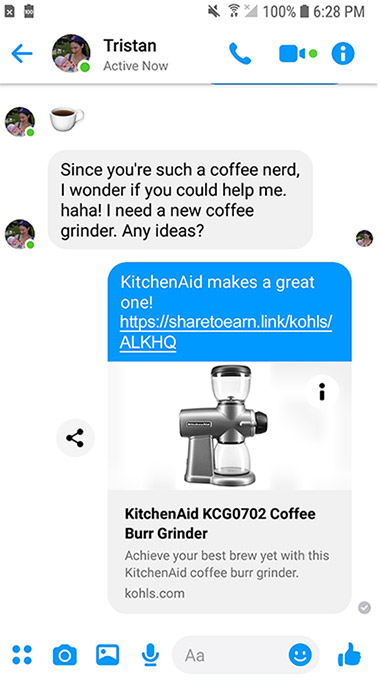
When consumers share links to products or services, it's most often relating to a specific item, for example:
Mentions of the Product or Merchant
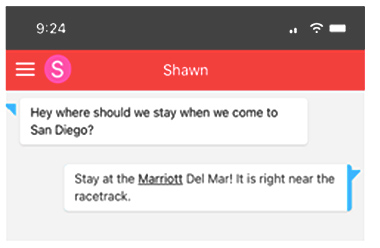
Alternatively, consumers often skip the step of including a link and simply mention the product or merchant in their message:
Contextually Relevant Recommendations
The reasons that retailers' and brands' efforts to motivate and reward these personal recommendations fall short are driven by two factors:
- Personal recommendations are, by their very essence, ad-hoc and fragmented across the many ways and channels through which people communicate; and
- Advertisers fear disrupting the most potent aspect of a personal recommendation, its authenticity.
Platforms are emerging that address both concerns, allowing advertisers to execute multichannel programs that tap into, rather than disrupt, authenticity.
The most authentic recommendations are those that are contextually relevant to a conversation and come from one-on-one communications, like DMs and text messages, as in the above examples.
According to our research, 99 percent of respondents trust recommendations from friends or family more than they trust advertising, and 96 percent of respondents have purchased from their phones based on a direct recommendation they received via text.
The key challenge for advertisers has been the historical lack of technology that enables them to contextually insert themselves within the conversation in an authentic and unobtrusive way.
Keys to Successful Social Commerce Loyalty Programs
The next challenge for marketers is how to best leverage the untapped potential of social commerce in the true sense of the word: to motivate and reward recommenders contextually and naturally as they casually recommend products, services, and brands they're loyal to in their personal messages.
Four principles come into play for marketers when they're seeking to motivate and reward people for recommending their products via digital word of mouth:
- Effortless: Successful efforts and technologies fit naturally within social dialogue, harness existing user behavior, and do not require the recommender to take any extra steps.
- Omnichannel: Since digital word of mouth happens wherever people chat and share ideas, successful programs and technologies need to meet consumers where they already are by functioning across all platforms (mobile, desktop) and communication channels (text, apps, social media, etc.).
- Unobtrusive: It's critical to leverage authentic conversations among people and fit naturally and unobtrusively within the context of the conversation.
- Rewarding: Accurate tracking and attribution for social sharing are essential so that the person who makes recommendations can be rewarded if their suggestions result in purchases.
Brands must ensure their programs meet these criteria to build a successful social commerce-driven loyalty program and tap into the power of the unrealized $3 trillion in transactions from personal recommendations.
With these key elements in place, programs are more likely to sound authentic and successfully drive brand results.
Word of mouth no longer has to be an elusive source of increased sales for brands that are successful at turning customers into loyal advocates who are rewarded for organically sharing their recommendations.











 Loading ...