Enterprise employees and customer service representatives have long been forced to work between two systems: the contact center, where conversations occur, and the CRM, where those interactions are documented manually. But as generative AI and voice AI mature, that long-standing divide is beginning to disappear.
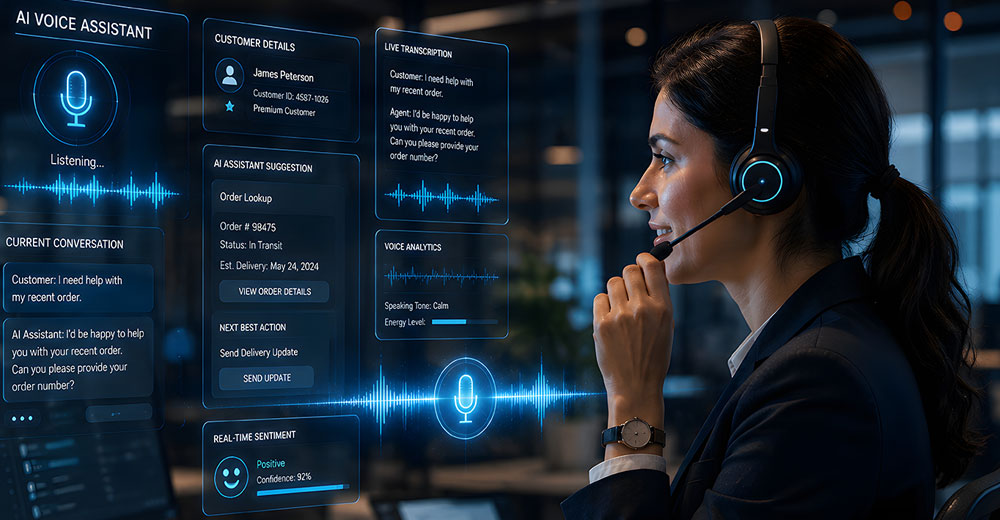
AI-powered voice assistants are changing how employees interact with CRM without forcing organizations to overhaul existing systems. Rather than replacing CRM, they sit on top of existing platforms, capturing customer conversations in real time, transcribing notes, updating records, tagging customer sentiment, and triggering backend actions across connected enterprise resource planning (ERP) and service systems.
Employees no longer have to manually log details across separate contact systems and databases because end-to-end speech-to-speech models and agentic AI enable voice assistants to handle complex, multi-step tasks through natural dialogue, rendering traditional interactive voice response (IVR) menu trees obsolete.
Industry analysts also see AI changing how employees use CRM systems. In an April 2025 analysis of the future of front-office software, Forrester wrote that CRM platforms will become increasingly accessible through AI agents and other business applications, with conversational interfaces becoming the primary user experience.
According to Gidi Adlersberg, Voca CIC business line manager at AudioCodes, conversational AI is transforming enterprise operations across customer-facing contact centers and internal employee service desks. He believes traditional CRM systems are evolving into passive data repositories in the AI era.
"The biggest driver is the maturity of AI, specifically conversational and voice AI, on the back of large language models. Voice AI has crossed a threshold: it's not just more capable; it's more accessible and more affordable. That combination is what makes this practical now, not just theoretically possible," Adlersberg told CRM Buyer.
Why Voice AI Changes CRM
Adlersberg explained that the old model trapped an agent or an internal support representative between a live platform and a manually updated CRM, logging interaction details by hand while half-listening to the customer. That splits their attention at exactly the moment it should be on the person in front of them.

"With voice AI, those interaction insights flow into the CRM automatically and in real time. No manual data entry, and the human stays focused on the conversation instead of the paperwork," he said.
As contact centers became more sophisticated while CRM systems continued to rely heavily on manual data entry, the disconnect between them became a significant operational bottleneck, Adlersberg noted. Enterprises were forced to decide whether employees should primarily work in the contact center application, where conversations occur, or in the CRM, where customer knowledge is stored.
"For years, there was no clean answer, so the person delivering service, externally to customers or internally within the organization, had to juggle both. They'd bounce between the contact center application and the CRM in the middle of a live interaction," he added.
That created a long-running debate over which platform should become employees' primary workspace. Do you pull contact center controls into the CRM, or pull CRM data into the contact center? The contact center was the interaction hub, the CRM was the data hub, and each side wanted to own the main screen.
"The user got stuck in the gap between them. That gap is the bottleneck. It's friction sitting right at the point of every customer or employee interaction, which is the worst possible place to have it," Adlersberg explained.
From Workflow Hub to Intelligent Voice AI Layer
Adlersberg described traditional CRM as a stack of layers with the bottom holding the data layer, the database, the tables, and the raw information. On top was the UI layer, where all the values got added. The quality of that CRM layer depends on how easily users can access, edit, group, summarize, and report on that data.
AI collapses that middle layer from both directions. On the input side, voice AI automatically populates the CRM. All those fields a user once filled out by hand no longer exist. On the consumption side, instead of navigating menus and building reports through the UI, a plain-language AI prompt layer sits atop the CRM.
"So the UI layer, the thing that used to define a good CRM, becomes largely irrelevant. What's left is the data layer underneath and the AI layer on top," Adlersberg said.
CRM stops being the primary interface for getting work done. It becomes the organization's system of record, quietly holding customer data while voice AI handles input and prompting manages output.
"It's still essential, but it's no longer where humans spend their time," he clarified.
Voice AI Solves CRM's Internal Operations Challenges
According to Adlersberg, three challenges are specific to internal operations that play right to voice AI's strengths in making CRM systems better.
The first is chronic under-measurement. Customer-facing contact centers are heavily instrumented, with every metric tracked and every call analyzed. Internal desks are the opposite. IT and HR support handle high volumes of interactions, but almost none of them are captured or analyzed in any meaningful way.
The second challenge is improving the employee experience. This approach is short-sighted because it ties directly to revenue and treats the employee side as an afterthought. But if you improve employees' working lives, you improve the customer experience downstream, he reasoned.
"Support reps who aren't fighting their own IT desk all day show up better for the customer. So the internal desk isn't a side issue. It's upstream of the thing every enterprise already says it cares about."
The third is that internal problems are repetitive and structured in a way that voice AI handles well. They involve the same access requests, repetitive onboarding questions, and policy lookups. Because the enterprise controls the entire internal ecosystem, its own systems, policies, and identity, there is far less friction to deploying automation than in the messy, open-ended world of external customer support.
"The environment is known so that the AI can act on it with confidence," he concluded.























 Loading ...