

Conventional wisdom suggests that the more information a person has concerning a particular issue or event, the more likely they are to accurately predict the outcome. This applies to such diverse areas as baseball, meteorology, and, of course, business.
The challenge, however, is deciphering which bits of information are germane to the objective at hand and which bits are extraneous to immediate concerns. After all, no successful baseball manager is going to request a batter’s hit chart against right-handed pitching when there is a left-hander on the mound. Such information would be inapplicable to the task at hand. The same theory applies to the business use of Web analytics solutions.
Web analytics refers to the measurement and analysis of online customer behavior. The guiding principle of Web analytics suggests that the more information a business collects on its online customers and Web page visitors, the more success they’ll have in targeting specific marketing campaigns and increasing conversion rates. However, just as in baseball, more information is collected than can be logically analyzed. Furthermore, not all data applies to all possible scenarios. The challenge for organizations is to make sense of the data collected through a Web analytics solution and use it to maximize top-line revenue from the online channel and increase marketing campaign effectiveness.
Turning Data Into Action
As the Web analytics space has matured over the last 10 years, businesses have realized the benefits of tracking Web site engagement. A disconnect occurs, however, when it comes to aggregating Web site statistics and data and transforming the information into actionable insights that can be used to improve marketing efforts, conversion rates, and customer retention.
For its upcoming benchmark report, “Web Analytics: Actionable Insights for Unlocking the Hidden Potential of Online Data,” Aberdeen has surveyed over 190 companies to understand the best practices for deriving business value and actionable information from an analytics solution. The report, which will be published on May 1, defines Best-in-Class performance using a combination of key metrics. An organization’s current and annual performance in online conversion rates, as well as its yearly performance in revenue per visit and customer profitability, determined whether or not a company scored as Best-in-Class, Industry Average or Laggard.
Free Versus Paid
Thirty-two percent of all survey respondents have been using a Web analytics solution for less than two years. This adoption trend roughly coincides with the availability of free Web analytics solutions. Free Web analytics platforms are enticing options for resource-constrained businesses that hope to better understand their online customers. Currently, 26 percent of Best-in-Class companies, compared to 38 percent of all others, use a free Web analytics solution. Best-in-Class companies, on the other hand, are 1.7 times more likely than all others to implement a paid solution. Surprisingly, a large percentage of Best-in-Class companies and all others, 41 percent and 35 percent respectively, opt for both a paid and free solution.
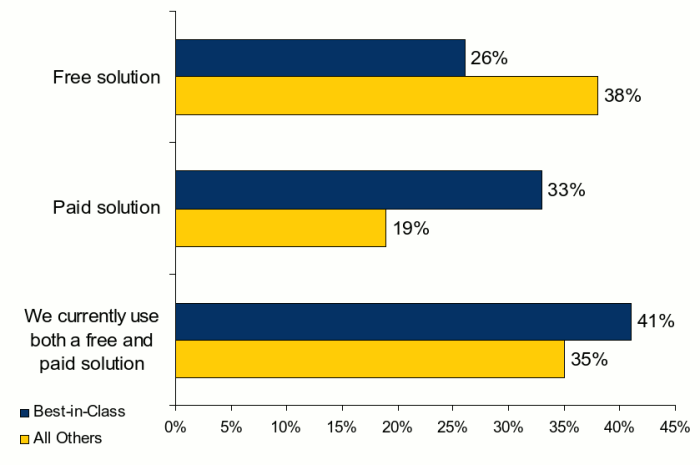 (Current Use of Web Analytics Solutions – click on image to enlarge)
Common Pitfalls of Web Analytics
Research reveals that a lack of insight as to how to convert key performance indicator/metric reporting into actionable strategy is the top frustration end-users experience, whether they leverage a free solution, a paid solution, or both.
Furthermore, 42 percent of companies using a free solution indicate that there are not enough resources at the organizational level to derive quantifiable business value from their free Web analytics solution. End-users leveraging free solutions are often faced with the reality of having to analyze data themselves due to the absence of professional service or consultancy offerings. Table 1 highlights the most common frustrations by solution type. The common theme that emerges is a difficulty analyzing data and the absence of organizational resources to devote exclusively to Web analytics.
Web Analytics Solution Type
Lack ofinsight as to how to convert KPIs/metric reporting into actionitems
Notenough resources at the organizational level to derive quantifiablebusiness value from free solution
Analytics data is difficult to interpret
Data isdifficult to extract from analysis platform
We donot perceive to be getting the full value from our web analyticssolution(s)
Datadelivered by the two separate systems does not always “matchup”
Free
44%
42%
23%
23%
21%
N/A
Paid
45%
24%
28%
28%
31%
N/A
Both
47%
33%
20%
16%
22%
29%
What are the Top Frustrations Your Company Experiences With Web Analytics?
According to 34 percent of Best-in-Class companies, the strength of a solution provider’s professional services and consultancy offerings is a key determinant when selecting a Web analytics solution provider. The correlation between the year-over-year improvements in key metrics and type of solution in place cannot be overlooked.
Respondents leveraging a paid solution are experiencing year-over-year improvements in key online metrics compared to those who leverage a free solution. Traditionally, free solutions have limited support for users, if any at all. While the free solutions can deliver vast amounts of online data, there is little guidance as to how to uncover the data points that matter to a particular company. Paid solutions, however, often include training programs and support services, albeit at an additional cost, to help end-users maximize their use of Web analytics.
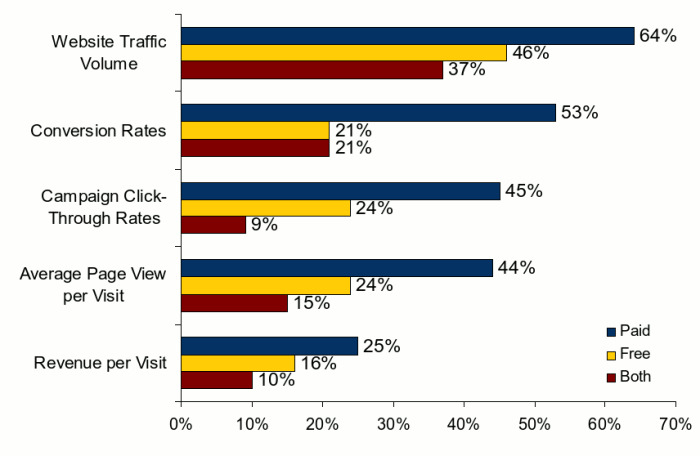 (Year-Over-Year Improvement in Key Metrics by Solution – click on image to enlarge)
Interestingly, respondents who used both a paid solution and a free solution struggled to derive as much business value as companies using only a paid solution. This is due, in part, to the fact that the data delivered by each system does not always “match up,” making it a challenge for end-users to determine which report is accurate and how the data can be used. In fact, the inconsistencies in the data were identified by 29 percent of respondents using both solution types as a top three frustration concerning their Web analytics experiences. While companies using both a free and paid solution did improve year-over-year performance in key metrics, one must wonder if their performance would be even greater if they settled on just one.
Aberdeen’s upcoming benchmark, “Web Analytics: Actionable Insights for Unlocking the Hidden Potential of Online Data,” will be available for free on May 1. In the meantime, the Research Preview is available for download now. If you would like to contribute to the ever-growing data set, please complete the online survey.
Alex Jefferies is a senior research associate for Aberdeen Group’s customer management technologies group.


















 Loading ...
































Social CRM
See all Social CRM